The Tale of Two Landlords (A Personal View)
In February 2021, Winter Storm Uri shut down the Texas grid. Two years later, in 2023, Winter Storm Mara snapped thousands of trees and power lines across Austin.
During both crises, I observed that landlords inevitably fell into two categories.
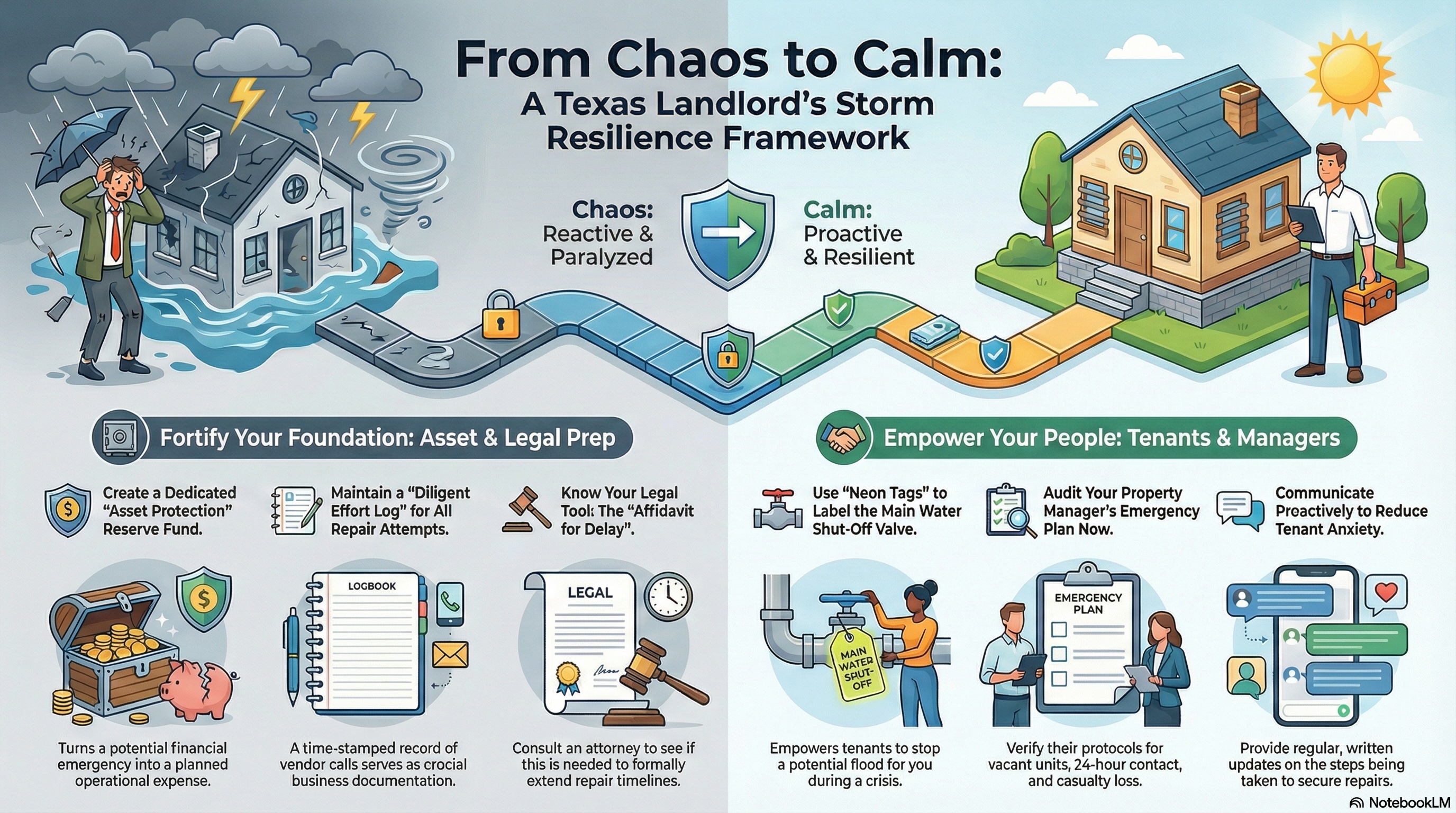
The "Reactive" Landlord spent the week glued to the news, anxiously refreshing their email, and hoping their insurance agent would call back. They were paralyzed because they were waiting for someone else to save the asset.
The "Resilient" Landlord had a plan. They knew their vendors personally, they had a financial cushion, and they communicated with their tenants before the first snowflake fell.
That experience confirmed a core belief: Real estate doesn't have to be frantic.
While we have since pivoted from active property management to real estate consulting, the lesson remains the same: You cannot control the weather, but you can control your infrastructure.
Here is the framework we use to bridge the gap between expectation and reality.
1. The Financial Foundation: Liquidity & Compliance
Many investors view rental income strictly as cash flow. However, seasoned investors view a portion of that income as "peace of mind." When a weather event hits, you need immediate liquidity because insurance claims often take weeks to process, but a plumber needs to be paid today.
The Operational Approach:
We recommend maintaining a dedicated "Asset Protection" reserve.
If You Self-Manage: Consult your CPA regarding the best banking structure for your specific entity to ensure funds are accessible but distinct from personal accounts.
If You Use a Manager: Ensure your funds are held in compliance with TREC Rule §535.146. Licensed brokers are strictly prohibited from commingling trust money with their own operating funds.
The Benefit: When a repair is needed, you are deploying resources you’ve already set aside. This turns a "financial emergency" into a simple "operational expense."
2. The Logistics Reality: Diligent Effort & Legal Mechanisms
In Texas, a landlord is generally required to make a "diligent effort" to repair conditions affecting health or safety. However, the law recognizes that you cannot fix what you cannot buy.
The TriLitCo Philosophy:
Documentation is your ally. We recommend two specific protocols:
The Internal "Diligent Effort Log": Maintain a time-stamped record of every call, email, and vendor inquiry. If parts are backordered, save the vendor’s written confirmation. This internal log serves as crucial business documentation of your activity.
The Statutory "Affidavit for Delay": Be aware that Texas law provides a specific legal mechanism (the Affidavit for Delay) that may be required to formally extend repair timelines during a disaster.
- Action Item: Consult a legal professional to determine if and when this affidavit is necessary for your specific situation. Do not rely solely on internal logs if a formal filing is required.
3. Tenant Education: The First Line of Defense
The best way to stop a flood is to empower the tenant to stop it for you. This requires education before the crisis.
The "Neon Tag" Protocol: Do not just tell tenants where the water shut-off is; label it. Attach a bright neon tag to the main water shut-off valve.
- The Instruction: "If water is flowing into the house and you cannot stop it, turn this handle."
The Instruction: "If water is flowing into the house and you cannot stop it, turn this handle."
The Tankless Water Heater Vulnerability: Many Central Texas homes have tankless units installed on the exterior which are vulnerable during power outages.
The Protocol: Do not create your own "how-to" guide. Improper technical instructions can shift liability to you if damage occurs. Instead, advise tenants to refer strictly to the manufacturer’s manual or instructions provided directly by a licensed professional regarding freeze protection for their specific unit.
4. The "Manager Audit" (If You Don't Self-Manage)
If you employ a third-party Property Manager, do not assume they have a plan. Verify it. Now—while the weather is calm—is the time to ask three specific questions.
The Emergency Definition: "Does your emergency protocol comply with Texas Property Code §92.020?"
(Context: You are legally required to provide a 24-hour telephone number for reporting emergencies that affect physical health or safety.)The Vacancy Check: "Who is checking on my empty units?"
(Context: Unchecked vacancies can lead to insurance claims issues. Ensure your PM has a specific team assigned to physically inspect vacant assets.)The "Casualty Loss" Rights: "How do we determine if a property is 'Totally Unusable'?"
(Context: Texas Property Code §92.054 may allow for lease termination if a property is "totally unusable." However, this is a specific legal conclusion. Ensure your manager knows to seek legal counsel to determine if this threshold is met before attempting to terminate a lease.)
5. The Human Element: Communication Goals
In our experience, anxiety comes from the unknown. When tenants feel uninformed, they feel unsafe.
We encourage a proactive communication style that we call "The Velvet Hammer"—clear, firm, and reassuring.
The Strategy: Instead of silence, provide regular, written status updates.
The Goal: Your communication should detail the specific steps taken to secure parts and labor (e.g., "We have contacted Vendor A and Vendor B").
- Note: If repairs will be delayed due to parts or labor shortages, consult your attorney regarding the use of the statutory Affidavit for Delay (Texas Property Code §92.0562) to ensure you are legally protected while keeping the tenant informed.
Note: If repairs will be delayed due to parts or labor shortages, consult your attorney regarding the use of the statutory Affidavit for Delay (Texas Property Code §92.0562) to ensure you are legally protected while keeping the tenant informed.
Conclusion: Stewardship in Action
Disasters are inevitable in Central Texas—whether it's the grid failure of '21 or the ice storm of '23. But the stress that comes with them is optional. By shifting your focus from "reacting to problems" to "stewarding relationships," you protect not only your asset but your own peace of mind.
This is the core of the Harmony over Hustle philosophy: Building systems today that allow you to rest easy tomorrow.
Let’s Refine Your Approach
When the next freeze arrives, will you be scrambling for a vendor, or relying on a verified protocol?"
Disclaimer: This article is for informational purposes only and does not constitute legal or financial advice. All references to the Texas Property Code and TREC rules are subject to change. Consult with a qualified attorney, CPA, or licensed property manager for your specific situation.