Most investors spend weeks researching a $40,000 car purchase, yet will hand over the keys to a $500,000 rental asset after a single phone call.
This discrepancy isn't just risky; it is fundamentally inefficient.
You are not simply hiring a vendor to collect rent; you are selecting a steward for your financial future. At TriLitCo, our transition from active management to real estate consulting allows us to offer an unvarnished, objective perspective. We help investors build compliant, profitable businesses that support—rather than disrupt—life-work harmony.
Experience suggests that selecting a manager without verified systems is akin to navigating 2026's regulatory complexity without a map. Based on our experience reviewing Central Texas portfolios, we have identified the "Operational Maturity" markers that separate a chaotic investment from a harmonious one.
Here is the 14-point framework to vet your next partner.
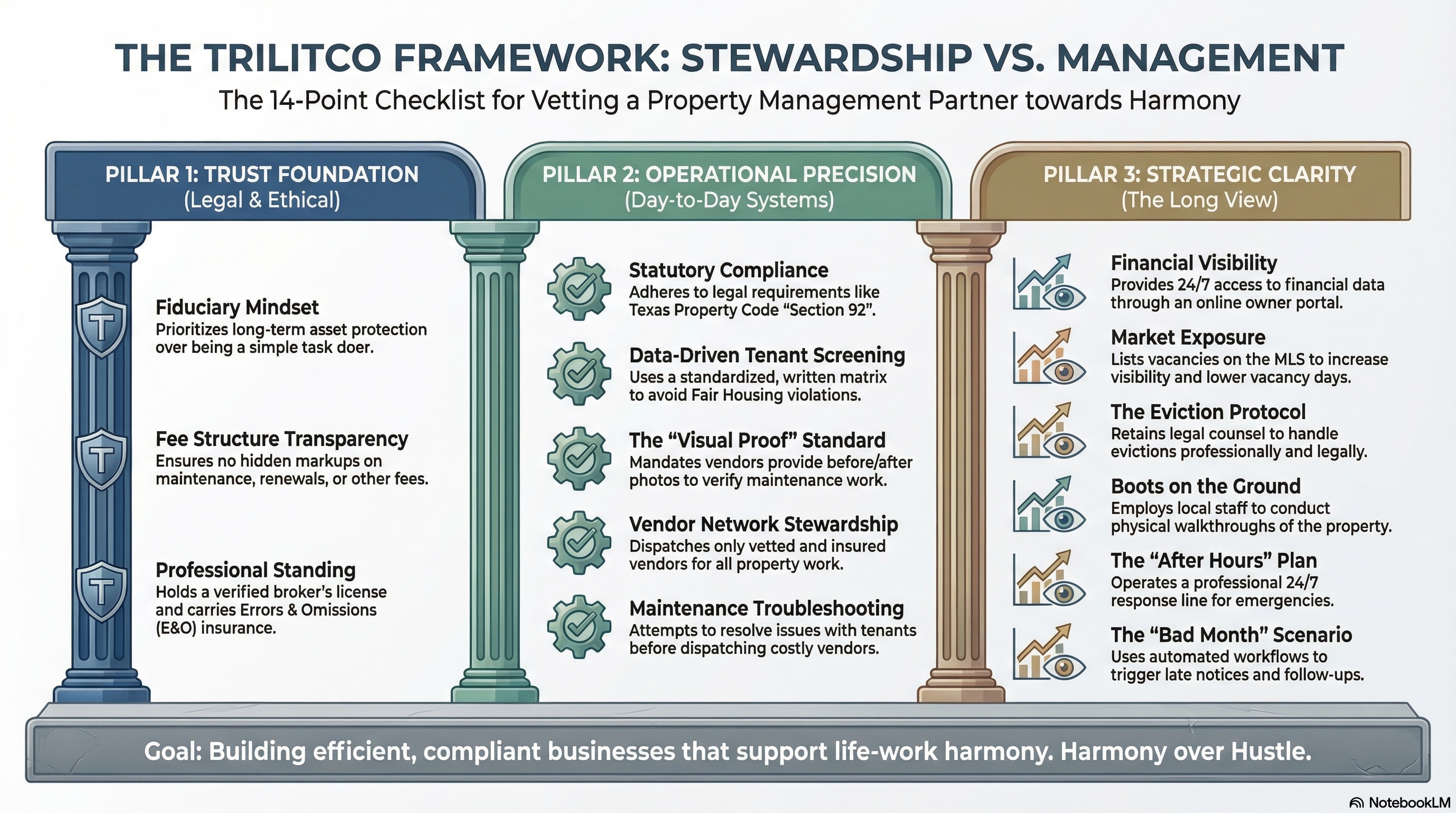
Pillar 1: The Foundation of Trust (Legal & Ethical)
A property manager acts as your financial proxy. This relationship must be transparent and legally sound.
1. The Fiduciary Mindset
Does the manager view themselves as a "functionary" (task-doer) or a "fiduciary" (asset-protector)? A fiduciary prioritizes long-term asset health over short-term convenience.
The Diagnostic: Ask how they handle security deposit disputes. If the answer is "we just deduct everything," this approach often lacks the documentation required to withstand a dispute. A true steward uses a rigorous, evidence-based system for deductions.
2. Fee Structure Transparency
Complexity often hides cost. We advise caution with "low entry price" models that mask high ancillary charges. Note: Per the Sherman Antitrust Act, all professional fees are negotiable.
The Diagnostic: Ask specifically: "What is covered by the monthly fee, and exactly what is billed as an extra?" Look for markups on maintenance, lease renewals, and "technology" fees.
3. Professional Standing (License & Insurance)
Property management is a regulated activity in Texas requiring a broker's license. Beyond this legal baseline, a professional operation should carry Errors & Omissions (E&O) insurance.
The Check: Verify their license status directly at the Texas Real Estate Commission (TREC) and request to see a current certificate of insurance.
Pillar 2: Operational Precision (The Day-to-Day)
Great systems are boring. You want a "boring" management experience because it means compliance protocols are working.
4. Statutory Compliance: The "Section 92" Test
The Texas Property Code (Chapter 92) dictates strict timelines for security devices and smoke detectors.
The Diagnostic: Ask: "How does your team ensure compliance with Section 92 rekeying requirements?" Adherence is critical for habitability and liability protection.
Note: Always consult your attorney regarding specific code requirements.
5. Data-Driven Tenant Screening
A "gut feeling" is a liability risk. Professional screening requires a standardized matrix that objectively evaluates credit, criminal history, and rental verification.
The Check: Ask to see their written "Rental Criteria." If they cannot produce a document, they may be inadvertently risking Fair Housing violations.
6. The "Visual Proof" Standard
In a digital world, you should not have to rely on a text message. Maintenance must be documented visually.
The Diagnostic: Do they use software that mandates vendors upload "Before and After" photos before payment? This workflow significantly reduces "phantom" maintenance costs.
7. Vendor Network Stewardship
Your manager is the gatekeeper of your property.
The Check: Ask how they vet vendors. Do they require W-9s and General Liability insurance on file before dispatching?.
8. Maintenance Troubleshooting
An efficient manager protects cash flow by troubleshooting issues before calling a vendor.
The Diagnostic: "Walk me through your workflow when a tenant reports a broken garbage disposal." The correct answer involves troubleshooting (e.g., the reset button) before dispatching a plumber.
Pillar 3: Strategic Clarity (The Long View)
Your property is an investment vehicle. Your manager should provide the data necessary to steer it.
9. Financial Visibility
Modern stewardship implies 24/7 access to your financials. You should never have to chase data.
The Check: Request a sample Owner Statement. It must clearly delineate income, expenses, and reserve fund status.
10. Market Exposure (The MLS)
Vacancy is the silent killer of returns. Relying solely on a yard sign limits exposure.
The Diagnostic: "Do you list vacancies on the Austin MLS?" Collaboration with outside agents exponentially increases visibility and reduces vacancy days.
11. The Eviction Protocol
While we hope to avoid it, you need to know your manager can handle an eviction legally.
The Check: Ask who represents you in court. Do they have an attorney on retainer?
Note: Ensuring your manager avoids the Unauthorized Practice of Law protects your case from dismissal. Always consult legal counsel for eviction proceedings.
12. Boots on the Ground
Remote management has limits. There is no substitute for physical eyes on the asset.
The Diagnostic: "Do you have local staff who perform physical walkthroughs, or is this outsourced?".
13. The "After Hours" Plan
Real estate does not sleep. A pipe can burst at 2:00 AM.
The Check: Do they have a professional 24/7 emergency line, or does the call go to a voicemail that goes unchecked until Monday?
14. The "Bad Month" Scenario
Systems are tested when things go wrong.
The Diagnostic: "Walk me through your exact workflow if rent isn't paid on the 4th." You are looking for an automated trigger (Late Notice sent), not a manual reminder.
Summary
Real estate investing should support a harmonious life, not create a chaotic one. By selecting a manager who values systems, compliance, and transparency, you are building a foundation for Harmony.
How does this framework align with your current management setup? Which "Diagnostic" question will you ask next?