
Executive Snapshot
Objective:
Equip owners with a structured five-gate framework to evaluate whether a single-family or small multifamily rental property merits acquisition—ensuring financial viability, compliance readiness, operational feasibility, systems clarity, and life alignment are verified before committing capital.
Key Takeaways:
The question "Does this deal make sense?" conceals five simultaneous judgments—one for each dimension of ownership responsibility
A property can pass financial analysis and fail operational capacity, compliance awareness, or life alignment—making it a bad investment for you even if the numbers work
Conservative underwriting in Central Texas (early 2026) requires current rent comps, 4-8 week turnover vacancy modeling, and stress-testing against modest adverse conditions
Confidence comes from knowing your stress thresholds across all five gates—not from optimistic base-case projections
Best Use Case:
Investors preparing to evaluate a specific property who want a complete decision checklist before committing capital.
The Real Question Isn't "Does This Deal Cash Flow?"
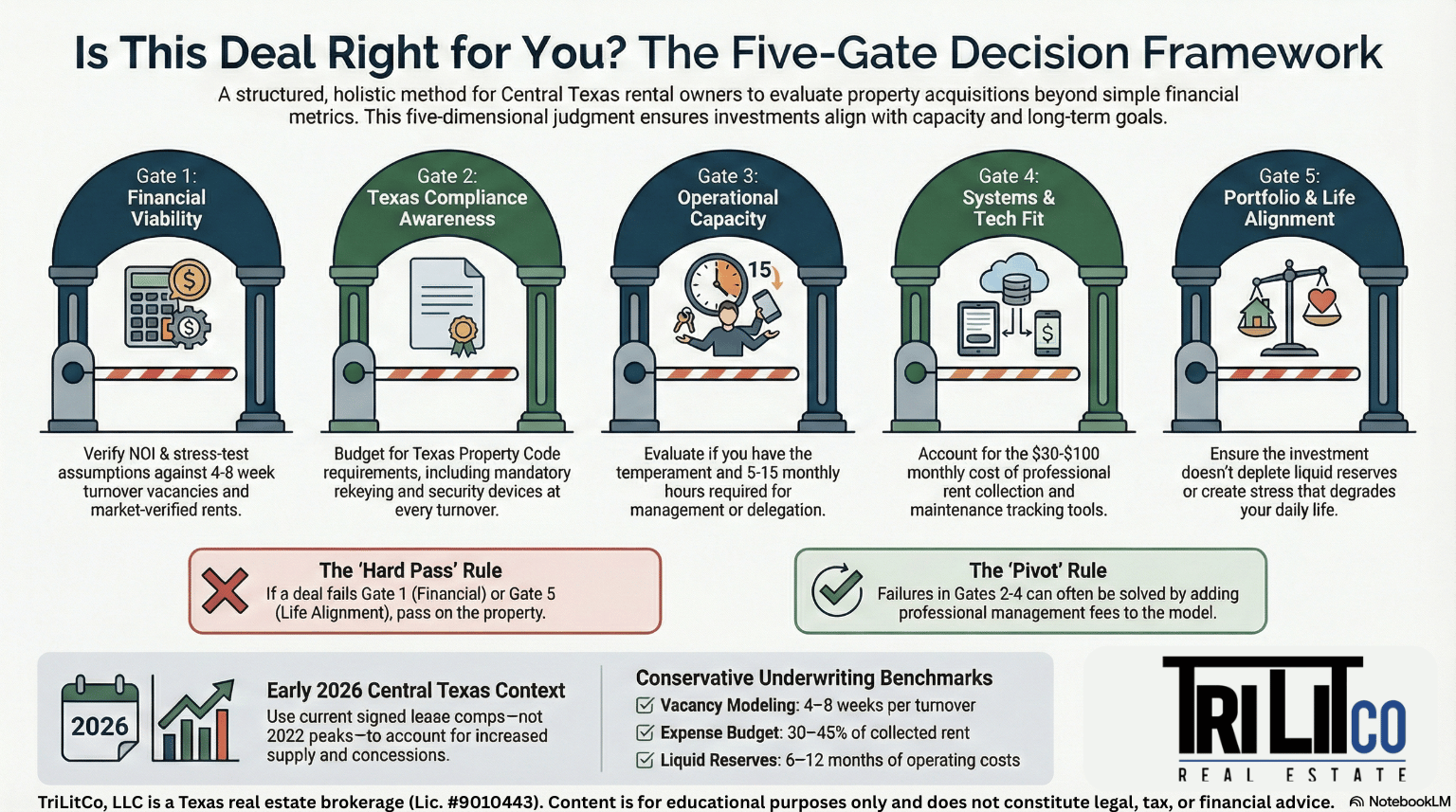
Newer investors treat property analysis as a formula problem—run the numbers, compare to a benchmark, decide. In practice, the question "Does this deal make sense?" conceals five simultaneous judgments:
Financial Viability — Does the property generate acceptable returns under conservative, verified assumptions?
Compliance Awareness — Do I understand Texas landlord obligations and have I budgeted for compliance costs?
Operational Capacity — Do I have the time, expertise, and temperament to manage this property (or resources to delegate)?
Systems & Technology Fit — What tools do I need, and have I accounted for their cost?
Portfolio & Life Alignment — Does this investment fit my broader financial strategy and support the life I want?
A property can pass one test and fail another. Financial viability without operational capacity leads to burnout. Strong operations without compliance awareness leads to legal exposure. Strong financials without life alignment degrades quality of life.
The goal: informed, high-confidence judgment across all five dimensions.
Gate 1: Financial Viability
The Question: Does this property support a clear proceed decision under conservative, market-verified assumptions?
Evaluation Criteria:
Returns support a clear proceed/pass decision accounting for your financing, opportunity cost, and risk tolerance
Positive NOI (operations self-sustaining before debt service)
Stress-tested scenarios (rent -$150/month, expenses +20%, extended vacancy, Year 2 CapEx event) do not flip your decision from proceed to pass
Appropriate metrics applied to asset type:
- Single-family & 2-4 units: Cash-on-cash return is primary
- 2-4 units: Cap rate as secondary lens alongside comparable sales
- 5-20 units: Cap rate is primary (income-approach valuation)
Single-family & 2-4 units: Cash-on-cash return is primary
2-4 units: Cap rate as secondary lens alongside comparable sales
5-20 units: Cap rate is primary (income-approach valuation)
All assumptions verified against local market data—rent comps from signed leases, expense quotes from actual providers, vacancy modeling aligned with property type
Red Flags:
Rent assumptions >5% above verified comparable leases
Negative cash flow under conservative assumptions without clear time-bounded rationale
Proceed decision dependent on aggressive appreciation or rent growth projections
Seller-provided numbers accepted without independent verification
Verdict: If the property fails financial viability under conservative assumptions, other factors rarely compensate. This gate is necessary but not sufficient.
Gate 2: Compliance Awareness
The Question: Do I understand Texas landlord obligations, and have I accounted for their cost and complexity?
Evaluation Criteria:
Awareness of Texas Property Code requirements affecting operations:
- Lock rekeying within 7 days of each turnover (landlord expense)
- Security device requirements (deadbolts, peepholes, window latches, sliding door security)
- Repair timelines for routine health/safety conditions (generally 7 days from written notice); emergency conditions such as sewage backup or flooding require immediate action
- Security deposit return (30 days after move-out)
Lock rekeying within 7 days of each turnover (landlord expense)
Security device requirements (deadbolts, peepholes, window latches, sliding door security)
Repair timelines for routine health/safety conditions (generally 7 days from written notice); emergency conditions such as sewage backup or flooding require immediate action
Security deposit return (30 days after move-out)
Compliance costs budgeted in operating expenses ($200-500 per turnover for locks/security devices; ongoing maintenance)
Understanding that non-compliance creates tenant remedies (lease termination rights, repair-and-deduct, legal liability)
Awareness of fair housing obligations and tenant screening requirements (FCRA compliance, adverse action notices)
Red Flags:
No awareness of Texas-specific landlord obligations
Compliance costs not included in expense projections
Assumption that "common sense" landlording satisfies legal requirements
Plan to handle evictions/disputes without understanding proper legal process
Verdict: Compliance is not optional. This gate is about awareness and cost integration, not legal advice—consult an attorney for specific compliance questions.
Gate 3: Operational Capacity
The Question: Do I have the time, expertise, and temperament to manage this property—or resources to delegate effectively?
Evaluation Criteria:
Time availability: Can you commit 5-15 hours monthly during stable periods, and 40-100 hours during turnover, without sacrificing career/family obligations?
Expertise: Do you understand tenant screening, lease enforcement, maintenance coordination, vendor management? If not, are you willing to learn or pay for professional management?
Temperament: Are you emotionally resilient to tenant conflicts, late-night emergencies, eviction proceedings, unexpected repairs?
Delegation readiness: If using professional management, have you verified the property cash flows with 8-10% management fees included?
Red Flags:
Demanding career/family obligations with no management delegation plan
No experience with tenant relations/maintenance coordination—and no budget for professional management
Low stress tolerance for conflict, uncertainty, operational disruption
Property only cash flows under self-management assumption with no transition path
Verdict: A property you cannot operate successfully will not deliver projected returns regardless of the math.
Gate 4: Systems & Technology Fit
The Question: What tools will I need to operate this property, and have I accounted for their cost?
Evaluation Criteria:
Rent collection: How will rent be collected? (Direct deposit, payment platform, checks?) What are costs and reliability?
Maintenance tracking: How will you document maintenance requests, vendor work, property condition? Documentation matters for disputes, compliance verification, tax records.
Tenant communication: What system for lease notices, maintenance updates, general communication? (Email, text, tenant portal?)
Financial tracking: How will you track income, expenses, reserve balances? Will your system integrate with tax preparation?
Cost integration: Have you budgeted $30-100 monthly ($360-1,200 annually) for software tools if using property management platforms?
Red Flags:
No plan for rent collection beyond "the tenant will pay somehow"
No system for documenting maintenance requests and completed work
Reliance on memory or informal records for financial tracking
Assumption that technology costs are negligible or optional
Verdict: The systems you choose should reduce friction and create documentation, not add complexity. Budget for tools you'll actually use.
Gate 5: Portfolio & Life Alignment
The Question: Does this investment fit my broader financial strategy and support the life I want—or create stress and consume capacity I need elsewhere?
Evaluation Criteria:
Capital deployment: Is the equity you deploy better used elsewhere—emergency fund, retirement contributions, business investment, home purchase? Does this investment crowd out higher priorities?
Liquidity impact: After acquisition, will you maintain 6-12 months of property operating costs in liquid reserves, plus 6-12 months of personal living expenses? Can you absorb a $10,000-15,000 CapEx event without financial distress?
Portfolio concentration: Does this property diversify your holdings or concentrate risk? A second rental in the same neighborhood doubles geographic exposure. Is that intentional?
Life stage alignment: Are you in a life stage where illiquid investments and active management are compatible? Potential relocations, career transitions, family changes may require capital flexibility you won't have if equity is locked in real estate.
Quality of life: Will the operational burden create stress that degrades your daily life? Will you resent the investment during difficult periods?
Red Flags:
Acquisition depletes emergency reserves or retirement contributions
No liquid reserves remaining after closing
High geographic or asset-type concentration without intentional rationale
Life circumstances likely to change in ways requiring capital flexibility
History of stress/anxiety around financial uncertainty or conflict
Verdict: Financial returns are not true returns if they degrade life satisfaction or crowd out higher priorities. A property that passes Gates 1-4 but fails Gate 5 is not a good investment for you.
A property can pass one test and fail another. Financial viability without operational capacity leads to burnout. Strong operations without compliance awareness leads to legal exposure. Strong financials without life alignment degrades quality of life.
Rod Carabott
Applying the Five-Gate Model
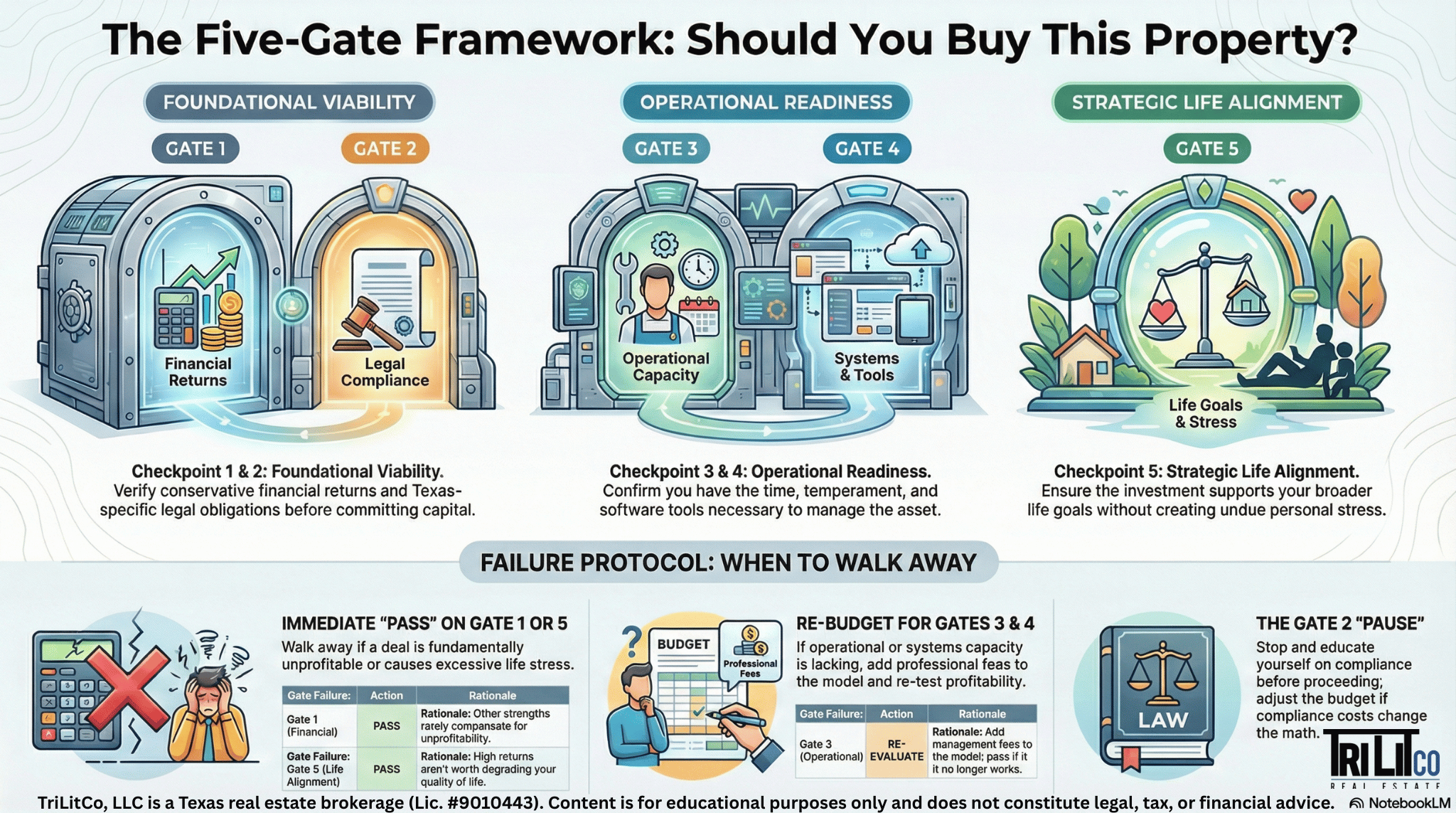
Pass all five gates: Proceed with confidence. The property demonstrates financial viability, compliance readiness, operational feasibility, systems clarity, and life alignment.
Fail one or more gates:
Gate 1 failure (Financial): Pass on this property. Other strengths rarely compensate for a fundamentally unprofitable investment.
Gate 2 failure (Compliance): Pause and educate. Understand obligations before proceeding, and re-budget if compliance costs change the financial picture.
Gate 3 failure (Operational): Add professional management fees to the financial model and re-evaluate Gate 1. If the property still works with management fees, proceed. If not, pass.
Gate 4 failure (Systems): Identify and budget for necessary tools. Re-evaluate Gate 1 if costs change materially. This gate is rarely fatal but often overlooked.
Gate 5 failure (Life Alignment): Pass, even if the property clears all other gates. A financially sound investment that creates life stress or crowds out priorities is not a good investment for you.
Central Texas Market Context (Early 2026)
For investors evaluating properties in the Austin metro area, current market conditions warrant conservative underwriting.
The rental market has softened notably from its 2021-2022 peak. Rent levels have declined from prior highs, and vacancy has increased—particularly in multifamily—as substantial new supply delivered in 2023-2024 absorbed into the market. Concessions (free rent periods, reduced deposits) remain common.
The wave of multifamily construction that peaked in 2023-2024 delivered substantial new supply into the market. Supply levels affect future rent and vacancy, but the direction and pace of change remain uncertain. Conservative underwriting uses current market conditions as the baseline and stress-tests against multiple scenarios rather than depending on supply predictions.
Underwriting guidance:
Use current market rents from recent signed leases—not 2022-era comparables or aspirational post-renovation rents
For single-family properties, model 4-8 weeks of vacancy per turnover (vacancy is a liquidity event, not a smooth percentage)
Model modest rent growth (0-2% annually) rather than pandemic-era appreciation trends
Budget 30-45% of collected rent for operating expenses; maintain 6-12 months liquid reserves for CapEx and vacancy events
Include Texas compliance costs in operating expense projections
Properties acquired in the current market may benefit from softened prices relative to 2022 peaks, but conservative assumptions remain prudent.
Your Team
Confident decision-making benefits from triangulating judgment across multiple perspectives. Your analysis benefits from advisors who have your interests in mind:
Buyer's agent with fiduciary duty to you (verify agency representation). Note: Current industry standards require a written buyer representation agreement before an agent can show you properties.
Independent inspector to assess property condition and major system remaining useful life
Property manager (even if you plan to self-manage) for rent comp validation and expense benchmarks
CPA or tax advisor for tax benefit verification
Attorney for lease review and compliance questions
The goal is not to outsource judgment but to verify your assumptions against specialized expertise before committing capital.