1. Executive Snapshot
Objective: To transition the lease renewal from a passive administrative task into a strategic capital reinvestment decision that accounts for the 2026 Texas regulatory landscape.
Key Takeaways:
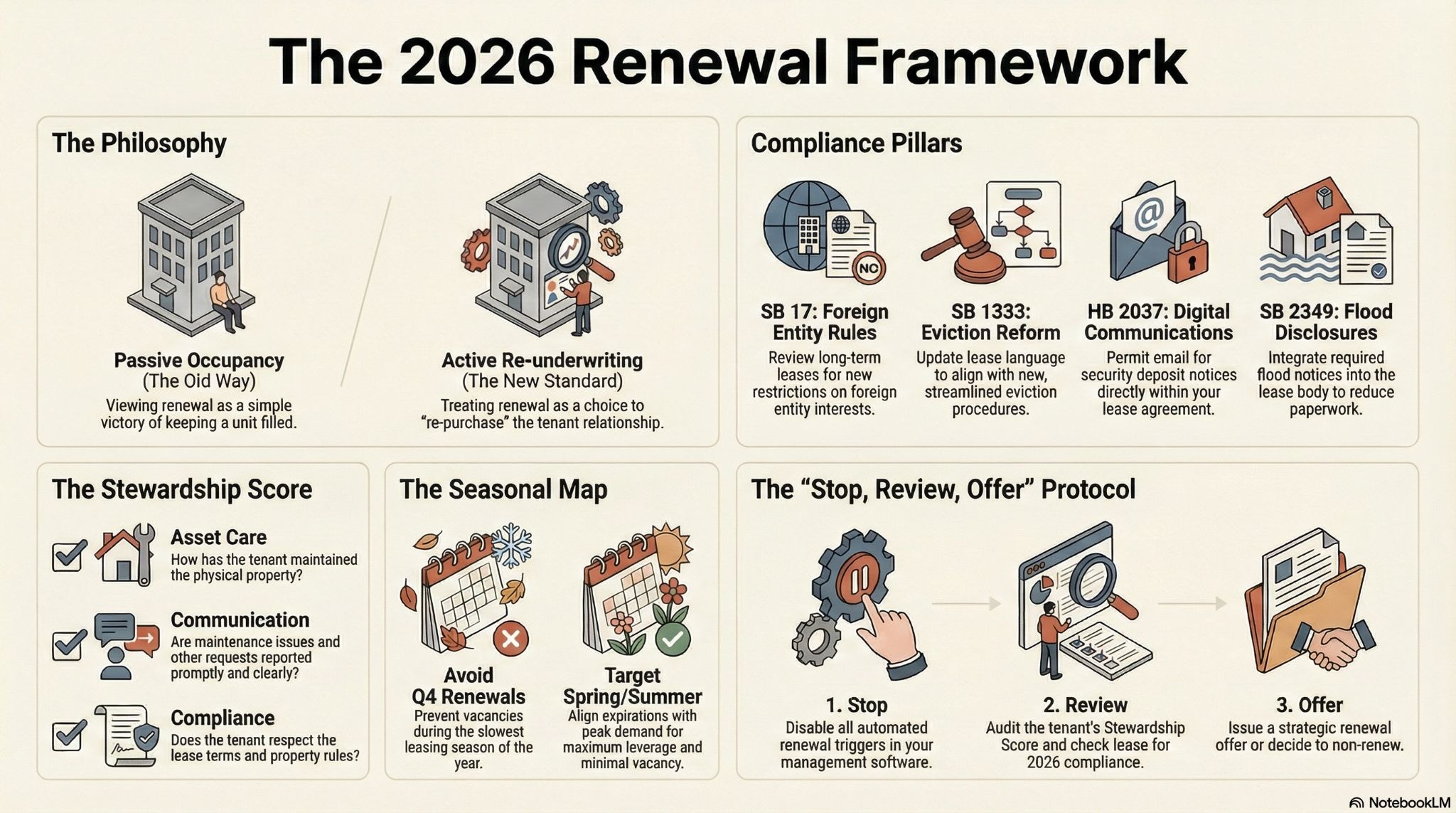
- Choosing to renew a lease is functionally equivalent to "re-purchasing" the tenant relationship for another 12 months.
- Statutory updates (including SB 17, SB 1333, HB 2037, and SB 2349) have modified eviction protocols, security deposit communications, and disclosure requirements.
- A strategic vacancy is often a viable alternative to a low-performance renewal that creates 12 months of operational friction or financial drag.
Choosing to renew a lease is functionally equivalent to "re-purchasing" the tenant relationship for another 12 months.
Statutory updates (including SB 17, SB 1333, HB 2037, and SB 2349) have modified eviction protocols, security deposit communications, and disclosure requirements.
A strategic vacancy is often a viable alternative to a low-performance renewal that creates 12 months of operational friction or financial drag.
Best Use Case: For residential owners with 1–20 units in Central Texas who are approaching a 90-day renewal window.
2. Reframing Renewal: Stewardship Over Speculation
In the rhythm of real estate ownership, the lease renewal is often treated as a victory of "occupancy." However, we view the renewal as a moment of active re-underwriting. When you offer a renewal, you are making a conscious decision to keep your capital locked into a specific contract.
The Reinvestment Concept Choosing to renew is functionally identical to buying the tenant relationship again. This shift in perspective moves the owner from a position of avoiding vacancy to a position of protecting the asset's long-term health.
Harmony Over Hustle A high-friction tenant creates administrative exhaustion and accelerates property wear. In the pursuit of life-work harmony, a strategic vacancy allows an owner to reset the asset and secure a tenant who aligns with a high stewardship standard.
3. The 2026 Compliance Baseline: The Operational Cost of Outdated Leases
The regulatory environment in Texas has evolved significantly as of early 2026. Utilizing a lease template from 2024 or early 2025 may not fully account for recent statutory shifts.
Eviction Reform (SB 1333) Effective January 1, 2026, the Texas eviction process has been restructured to focus strictly on the issue of possession. For owners, this suggests that lease language should be reviewed for alignment with these procedural shifts to support smoother proceedings during disputes.
Foreign Entity Restrictions (SB 17) As of September 1, 2025, new restrictions apply to specific foreign entities regarding land and leasehold interests. Owners should review lease terms exceeding one year for potential exposure under these new state requirements and consult counsel for specific language.
Flood Disclosure and Security Deposits (SB 2349 & HB 2037) Legislative updates have streamlined several administrative burdens. SB 2349 now allows flood notices to be integrated directly into the lease body rather than requiring standalone addenda. Furthermore, HB 2037 explicitly permits the use of email for security deposit communications, provided the consent is established within the lease. Updating documents to reflect these changes reduces administrative drag and modernizes your operational workflow.
4. Financial Reality: Adjusting for Yield and Margin Compression
When evaluating a renewal, "market rent" must be viewed through the lens of current maintenance baselines.
The Net Operating Income (NOI) Reality Renewing at a flat rate while overhead increases results in a mathematical decrease in Net Operating Income (NOI). Owners should weigh the stability of an existing tenant against the reality of increased professional service fees and material costs.
Decision Filter Analyze the "maintenance velocity" of the current tenant. If a tenant requires high-frequency service calls, the cost of servicing that lease in 2026 should be factored into the renewal offer.
5. The "Stewardship Score" Framework
To remove emotion from the renewal process, we recommend evaluating tenants based on a "Stewardship Score".
The Metric
Asset Care: How has the tenant maintained the physical plant?
Communication: Are issues reported promptly?
Compliance: Does the tenant respect the operational boundaries of the lease?
Grey-Area Handling Distinguishing between "normal wear and tear" and "tenant damage" remains a perennial grey area in Texas property management. We suggest acknowledging this ambiguity explicitly. Verification through a walkthrough before issuing a renewal offer can ground the decision in facts rather than assumptions.
6. Strategic Timing and the "Seasons of Demand"
A renewal is an opportunity to fix "calendar errors" like the "Holiday Trap," where a 12-month lease signed in November ensures future vacancies during the Q4 slowdown.
Optionality Consider 9-month or 15-month renewals to realign expirations with the Spring/Summer peak leasing window in Central Texas.
7. Conclusion: The "Stop, Review, Offer" Protocol
Before your next lease expiration, we recommend a disciplined three-step approach:
Stop: Disable any "auto-renew" or automated email triggers in your management software.
Review: Audit the tenant’s Stewardship Score and evaluate lease terms for potential exposure under 2026 statutes (SB 17, SB 1333, HB 2037, and SB 2349).
Offer: Issue a renewal that reflects 2026 financial and regulatory realities, or make the proactive decision to non-renew to protect the asset’s long-term health.
Collaborative Footer & Disclaimers TriLitCo provides operational context on statutes like SB 1333 and HB 2037 but is not a law firm. Specific lease language should be reviewed by a licensed attorney. While the impact of SB 17 on residential renewal procedures is still being interpreted by legal experts, we advise a conservative approach to evaluation until case law settles. Consult your attorney or CPA for specific legal or tax guidance.